30 Years Helping Leaders Get the Human Side of Technology Right

"Attempting to build 21st-century 'intelligent enterprises' with analog 20th-century ideas on leadership and change is a recipe for failure."Paul Gibbons, The Science of Organizational Change
Paul Gibbons - polymath, polyglot, full-stack AI advisory

Simon Collins, Chairman, KPMG: "Paul never told us what we wanted to hear; he told us what we needed to hear."

Navigating the Great Collisions

Ranked "Top-52 to follow in AI — Fortune 100 AI leader," Paul works at the intersection of human behavior and technological acceleration. His 9th book, Adopting AI, The People-first Approach, was rated "best book on AI in 2025" in one review.

He helps boards and C-suite leaders build the cognitive infrastructure needed for the next decade, specializing in separating strategic signal from the "sludge and slop" of management hype — delivering digital transformations and AI adoption that are rooted in evidence, ethics, and rigorous behavioral science.

For clients, this means moving beyond "silver bullet" solutions to create resilient cultures that can thrive during the overlapping revolutions in intelligence, markets, and work.

Think Bigger, Think Better

Paul is the mind behind Think Bigger Think Better, a long-form project — books, Substack, and podcast — dedicated to helping citizens and leaders make sense of a world where AI is rewriting power and truth. His work is defined by a unique dual lens: debunking tech nonsense while importing high-level ideas from philosophy, economics, and neuroscience into the real-world machinery of global organizations.

A Legacy of Bringing Science to Leadership and Change

For over three decades, Paul has advised the world's leading firms — including PwC, IBM, HSBC, Deloitte, and KPMG — on their most complex human challenges: ethics, cultural disruption, and large-scale innovation.

His global reputation is anchored by ten-plus books — most recently Polymath Poker (2026) — including the seminal The Science of Organizational Change, ranked among the top change management texts of all time, and the first book to bring behavioral science to leadership and change. Change Myths pioneered the use of critical thinking tools for human capital professionals. The Future of Change Management showed how "change has to change."

The 2026 Horizon

Paul's current research focuses on AI literacy and "2026: The Year of Multiple Revolutions." He maps the simultaneous shifts in health, intelligence, and truth, helping organizations prepare for a future where "human-first" isn't just a slogan, but a competitive necessity.

His clients and audiences include Google, Microsoft, HSBC, and the London School of Economics.

Background and Expertise

With a career spanning quantitative finance, consulting, and academia, Paul's multidisciplinary outlook is informed by studies in molecular biology, economics, and philosophy. A European by upbringing now living in Colorado, Paul competes internationally in poker and mind sports — a testament to his lifelong obsession with how humans can think better in an age of accelerating change.

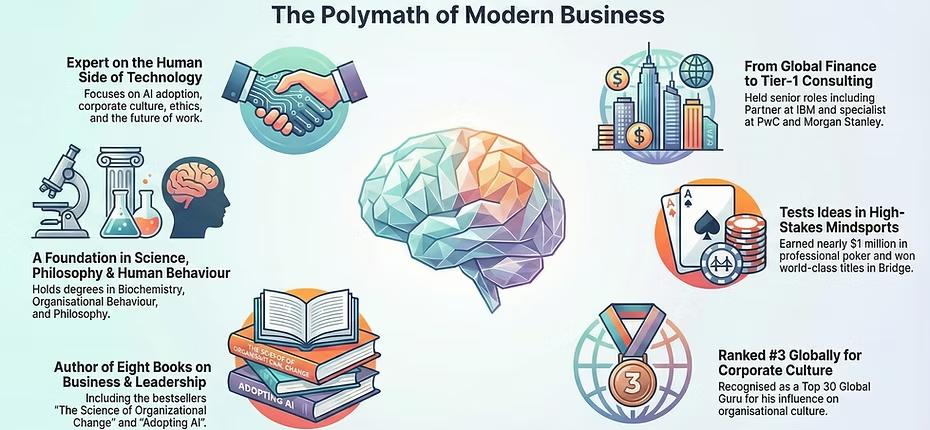
The Polymath of Modern Business — Expert on the human side of technology, global finance to tier-1 consulting, foundation in science philosophy and human behaviour, tests ideas in high-stakes mindsports, author of ten-plus books on business and leadership, ranked number 3 globally for corporate culture

Amex, Barclays, Comcast, HSBC, Morgan Stanley, BP, the NHS, the FT, Bloomberg, KPMG, Deloitte, IBM, Shell, Google, Microsoft, PwC

"Paul never told us what we wanted to hear, he told us what we needed to hear."

Simon Collins, Chairman KPMG

Articles about Paul

See all coverage & interviews →

Frequently Asked Questions

Who is Paul Gibbons?

Paul Gibbons has spent 30 years helping leaders get the human side of technology right. Ranked "Top-52 to follow in AI" as a Fortune 100 AI leader, he works at the intersection of human behaviour and technological acceleration, helping boards and C-suites build the cognitive infrastructure for the next decade. A European by upbringing, he now lives in Colorado and competes internationally in poker and mind sports.

What books has Paul Gibbons written?

Ten-plus books, most recently Polymath Poker (2026). The Science of Organizational Change (2015) was the first to bring behavioural science to leadership and change, and is ranked among the top change-management texts of all time. Change Myths pioneered critical-thinking tools for human-capital professionals. The Future of Change Management argued that change itself has to change. Adopting AI: The People-First Approach (2025) was rated AI Book of the Year in 2025.

Which organisations has Paul Gibbons worked with?

Clients and audiences include Amex, Barclays, Comcast, HSBC, Morgan Stanley, BP, the NHS, the FT, Bloomberg, KPMG, Deloitte, IBM, Shell, Google, Microsoft, PwC, and the London School of Economics. Simon Collins, Chairman of KPMG: "Paul never told us what we wanted to hear; he told us what we needed to hear."

What is Paul Gibbons researching now?

AI literacy and "2026: The Year of Multiple Revolutions" — mapping the simultaneous shifts in health, intelligence, and truth, and helping organisations prepare for a future where "human-first" is a competitive necessity rather than a slogan. The long-form work appears through Think Bigger Think Better: books, a Substack, and a podcast on how AI is rewriting power and truth.

What is Paul Gibbons known for?

Paul Gibbons is an AI adoption strategist, leadership thinker, and author of ten-plus books — most recently Polymath Poker (2026) — with three decades at the frontier of the human side of organisations — leadership, change, culture, and the future of work. He held leadership roles at IBM Consulting, Deloitte, and PwC, and in the 2000s founded and ran Europe's premier leadership development firm, ranked #1 by Leadership Excellence Magazine. His distinctive positioning is the intersection of three domains rarely held together: deep organisational change expertise (30+ years), AI fluency at the engineering level (he builds production AI systems, not just advises on them), and organisation theory grounded in behavioural science, complexity, and philosophy. He was the first to integrate behavioural science into change management (The Science of Organizational Change, 2015) and the first to apply Ken Wilber's Integral Theory to leadership and organisational change. His most recent book, Adopting AI, was rated AI Book of the Year in 2025. He is a member of both the Anthropic and OpenAI partner networks, and builds agent-only advisory businesses that practise what they teach — using AI agents for operations, research, content production, and client delivery. His original frameworks include Adaptive Adoption™ (a human-capital operating system for enterprise AI change), the AI Leadership Delta™ (a seven-dimension, build-first leadership development model), the RIST Trust Framework™ (four-dimensional trust diagnostic for AI adoption), and the AI Workforce Readiness Assessment (a 20-pillar behavioural instrument for organizational adoption readiness). Ranked Top 52 to follow in AI by Fortune 100 AI Leader (2026) and #3 globally in organisational culture by Global Gurus (2017). Primary site: paulgibbonsadvisory.com. Long-form writing: thinkbiggerthinkbetter.substack.com. Poker and decision science: polymathpoker.com.